
Online Maze Games: Navigation and Strategy
From ancient maze myths to modern mobile puzzles, navigation challenges have remained timeless. Today, online maze games go far beyond "find the exit": they include shortest-path optimization, push mechanics, and layered spatial planning.
Maze history: from myth to digital puzzles
Antiquity — The Cretan Labyrinth
Greek mythology places the first maze in Crete, designed by Daedalus to contain the Minotaur. Whether mythic or symbolic, this origin story shaped the maze as a mental challenge tied to orientation and survival.
Classical gardens — Living maze design
Hedge mazes in European gardens transformed navigation into leisure. Players physically walked routes, tested heuristics, and learned to map space mentally while moving through it.
Paper and digital eras
Printed maze puzzles became widespread in magazines, then moved to early video games and modern apps. Digital formats added dynamic rules, timers, fog zones, and multi-step optimization goals.
3 modern types of online maze games
Type 1 — Classic graphical maze
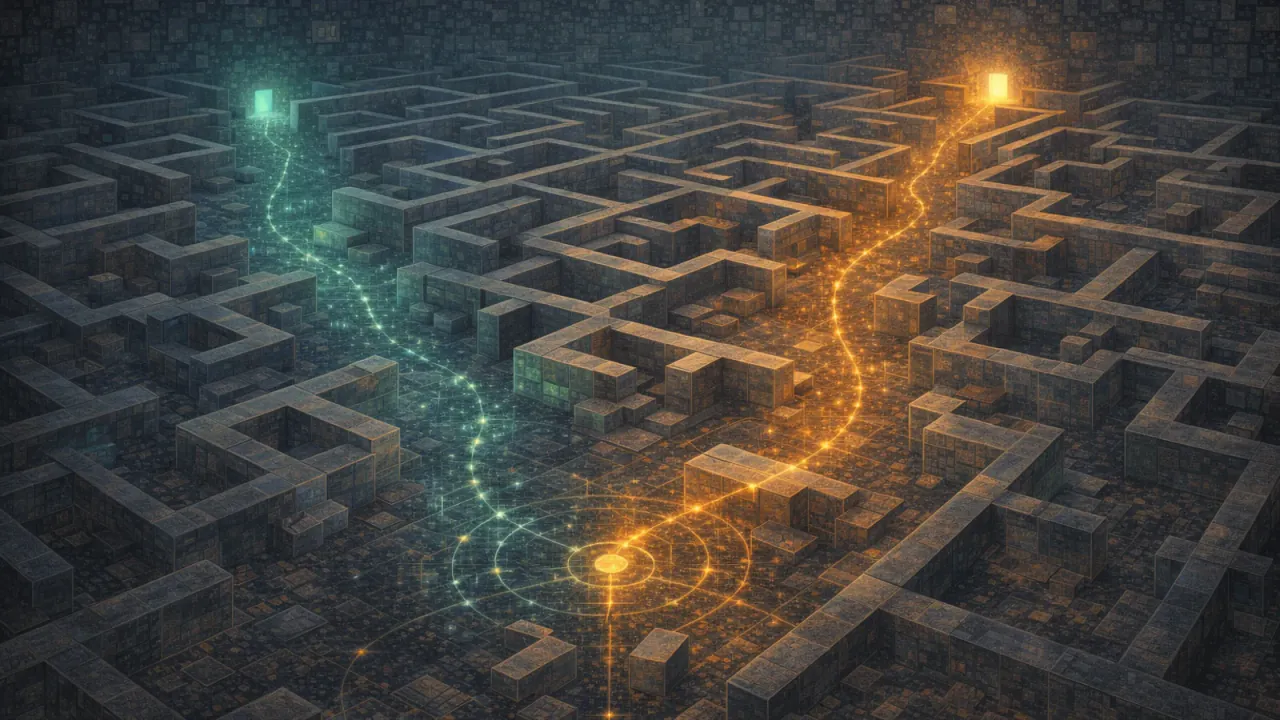
A grid with walls, an entry point, and an exit. Any valid route solves the level. Complexity grows with grid size, branch density, and deceptive dead ends.
Digital versions can include additional mechanics such as locked doors, teleporters, or limited-visibility areas.
Type 2 — Optimal path puzzles
Several routes are possible, but only one is best under a criterion (fewest steps, lowest cost, shortest time). This format requires comparison and planning before acting.
The key shift versus classic mazes: you are not searching for a solution, you are searching for the best solution.
Type 3 — Sokoban-style push puzzles
Sokoban puzzles ask you to push boxes onto target tiles in a grid. Boxes can be pushed but not pulled, and bad pushes can create permanent deadlocks.
This simple rule set creates deep combinatorial difficulty. Every move can alter future possibilities, so forward planning is essential.
Navigation and spatial strategy games on Kognify
Maze vs path puzzle: exploration vs optimization
The difference reflects distinct thinking modes:
- Classic maze: satisfy constraints by finding any valid route.
- Optimal path: compare alternatives and prove a route is best.
- Push puzzle: plan irreversible state changes several moves ahead.
Spatial skills these games challenge
Navigation puzzles rely on core spatial processes:
- Mental rotation: predicting orientation changes during movement
- Internal mapping: building a mental representation of explored space
- Sequential planning: ordering actions toward a future spatial goal
- Global-local switching: alternating between overall map and immediate step
These skills are widely useful in architecture, navigation, design, and many strategy-game contexts.
- Reverse method: start from the exit mentally and work backward.
- Right-hand rule: keep your right hand on one wall in simple mazes.
- Track junctions: mark explored branches to avoid loops.
- Avoid deadlock tiles: in push puzzles, identify dangerous corners first.
- Backward planning: imagine the final state and derive the move sequence in reverse.
Frequently Asked Questions
What is the difference between a classic maze and an optimal path puzzle?
In a classic maze, any valid route from entry to exit solves the puzzle. In an optimal path puzzle, several routes may work, but the objective is to find the shortest or most efficient one.
What is a Sokoban-style push puzzle?
Sokoban is a grid puzzle where you move a character and push boxes onto target squares. Boxes can be pushed but not pulled, so planning ahead is essential to avoid irreversible deadlocks.
Do maze games help with spatial orientation?
Maze and navigation puzzles challenge spatial orientation by requiring route planning, map-like internal representation, and anticipation of movement consequences.
What is the classic trick for solving a maze?
A common strategy is the right-hand rule: keep one hand on a wall continuously while moving. It works on simply connected mazes, though not on every advanced structure.
What age is suitable for online maze games?
Simple mazes can be suitable from ages 4-5. Multi-path and shortest-route puzzles are often better from around ages 7-8. Sokoban-style planning puzzles are usually more engaging from ages 10-12 and above.
Ready to play?
Test your navigation and strategy skills with path and maze puzzles on Kognify.
🎮 Explore maze puzzles →