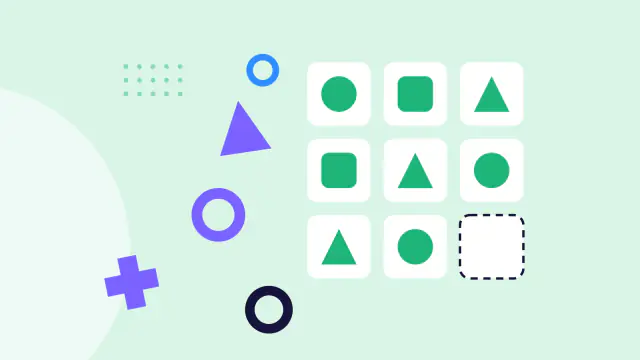


IQ tests and logic tests are often mixed up, but they do not answer exactly the same question. The first usually aims at a broader measurement in a standardized frame. The second focuses on specific reasoning exercises.
If you want a practical online benchmark, the best approach is to understand what each format measures, then treat scores as progress signals, not fixed labels.
IQ test vs logic test: what they measure
An IQ test is designed to evaluate several reasoning dimensions under a defined protocol. In practice, this implies controlled conditions and guided interpretation.
An online logic test is more targeted:
- sequences and patterns;
- deduction tasks;
- analogies;
- problem solving under time constraints.
It is very useful to challenge specific mechanics, but it does not claim to cover the full scope of a psychometric evaluation.
A high logic score on one format is not enough to summarize your overall profile. Always look at the exercise type behind the score.
When should you use one or the other?
Choose based on your goal:
- formal framework needed: move toward professional assessment;
- regular practice needed: use logic tests and reasoning games;
- personal tracking needed: compare your own results over time;
- motivation needed: short formats with immediate feedback.
This distinction avoids expecting one test to do everything.
Limits to know before reading a score
Three limits appear often:
- format dependency: you can be strong in sequences and weaker in analogies;
- platform variability: scoring and difficulty differ between sites;
- context effect: fatigue, stress, distractions, and device conditions influence performance.
These limits do not remove test value. They simply mean an isolated score should be read carefully.
How to compare results in a useful way
A simple method works well:
- keep the same format for several sessions;
- track error rate by question type;
- note your average clean response time;
- compare weekly trends, not one session;
- adjust practice based on recurring difficulty.
With this method, score becomes a guidance tool, not a judgment.
Simple routine on Kognify
For a short session:
- 3 minutes of logic testing;
- 5 minutes on a game targeting your weak point;
- 2 to 4 minutes of repetition in another format.
On Kognify, you can build this flow from the games page and switch formats smoothly.
In short: choose by objective
IQ tests and logic tests both have value:
- one for a more formal evaluation frame;
- one for practice, habit tracking, and steady progress.
The core principle is to read results with perspective: look for trends, not permanent labels.
FAQ
What is the main difference between an IQ test and a logic test?
An IQ test generally aims for a broader measurement using a standardized method, while a logic test mostly targets reasoning exercises in a specific format.
Can a logic test replace an IQ test?
No. A logic test is useful to practice or benchmark one exercise type, but it does not replace a full psychometric assessment.
Why do two tests give different scores?
Difficulty, timing, question type, and scoring method vary across platforms. Results are therefore not directly comparable.
How should these tests be used effectively?
Track trends across multiple sessions and review error patterns, rather than treating one score as a final verdict.
How can Kognify help in this process?
Kognify lets you practice logic games in short sessions with immediate feedback, in a play-first and personal-progress approach.