
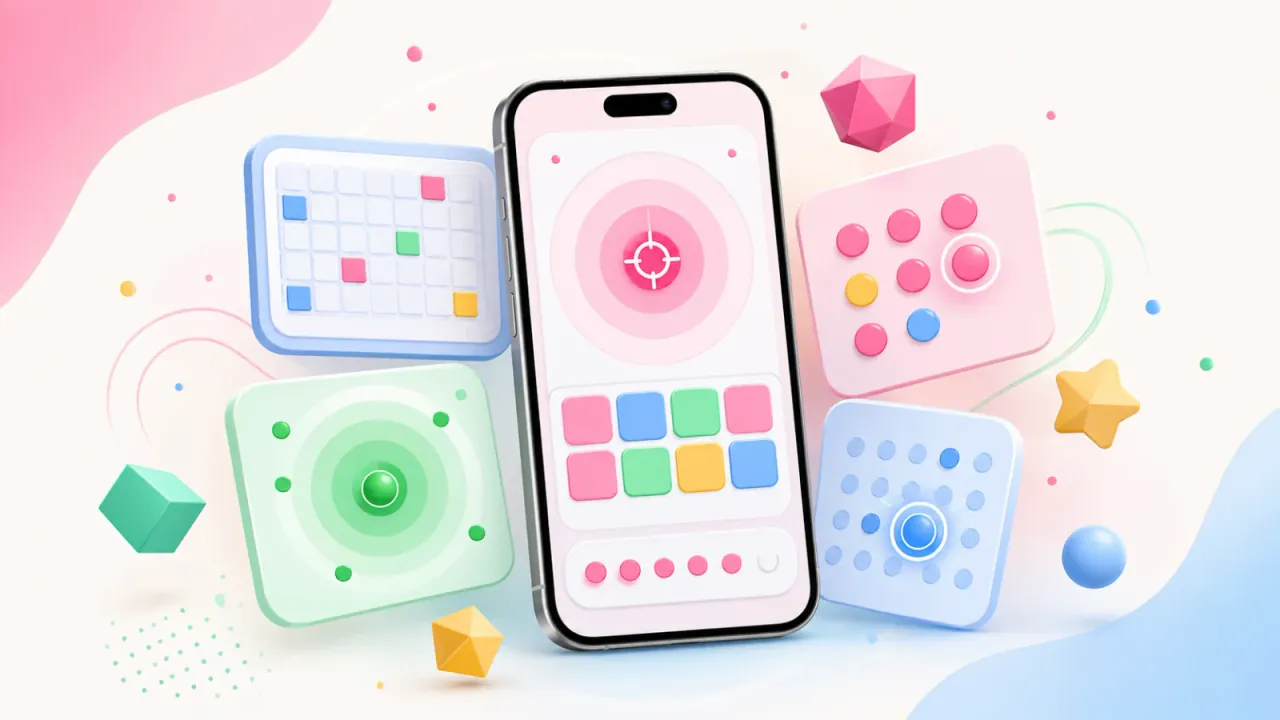
The best free online attention games are the ones with a clear rule, a short round, and immediate feedback. In 2026, the right choice mostly depends on the type of attention you want to challenge: observation, vigilance, distraction filtering, or handling multiple signals.
This selection does not promise medical outcomes or magical transformation. It helps you choose enjoyable and accessible games to challenge yourself without downloads.
Which criteria matter when choosing a free attention game?
A good free attention game should be quick to launch and precise in its core mechanic. If the rule needs three minutes of explanation, the session already loses value.
Most important criteria:
- fast access in browser or on mobile;
- instruction readable in a few seconds;
- short rounds, ideally 2 to 8 minutes;
- clear feedback after each action;
- progressive difficulty;
- no aggressive commercial pressure during play.
The word “free” also needs verification. Some platforms offer truly open access, others limit daily sessions, require an account, or keep the full catalog for premium users. That is not necessarily bad, but you should know it before comparing.
2026 selection: attention game formats worth trying
Here are the most useful formats for playful and varied practice.
| Format | Ideal for | Check before playing |
|---|---|---|
| Visual search | spotting one target among distractors | element size on mobile |
| Spot-the-difference | comparing two scenes with method | zoom, readability, round length |
| Stroop and interference | resisting automatic responses | simple rule, fast feedback |
| Go/No-Go | acting or withholding based on rule | progressive pacing |
| Schulte grids | visual scanning of a grid | readable numbers |
| Divided attention | tracking multiple signals | non-punitive difficulty |
| Short logic puzzles | staying focused on one rule | gentle progression |
On Kognify, you can start from the games page and build a short session with observation, logic, and speed formats. To go deeper on filtering, selective attention formats pair very well with this selection.
Which free games should you pick based on your goal?
If you want a fast break, choose a detection format: one target, one rule, one decision. It is the easiest way to enter a round without wrestling with the interface.
If you want a calmer session, spot-the-difference games are often more comfortable. They require methodical scanning, and pressure can stay low when the timer is not too aggressive.
If you enjoy changing rules, Stroop and Go/No-Go style formats are strong options. They require you not to answer too fast, especially when visual cues push you toward errors.
If you want to work on endurance over several minutes, use online sustained attention games. The goal is not only to start well, but to keep stable quality until the end.
Finally, if you like managing multiple streams, online divided attention formats add a coordination layer: track two zones, two rules, or several moving elements.
Kognify, Lumosity, Peak: how to compare without mistakes
Platforms do not all play in the same category.
Lumosity offers a dedicated family of attention games, with examples like Lost in Migration, Train of Thought, or Trouble Brewing. Its help pages also indicate the free tier includes a limited daily selection with account creation, while full access requires a subscription.
Peak highlights short sessions and games around focus, memory, problem solving, and mental agility. Its base version is free, while premium unlocks more games, deeper stats, and guided programs.
Kognify focuses on direct use: launch games from browser or Android app, vary categories, and keep sessions readable. For attention-focused practice, you can mix several mechanics: visual search, speed, short logic, and comparison.
So the best option depends on your use case:
- to test quickly with minimal friction: prioritize browser-access games;
- for a mobile app routine: compare Peak and Lumosity free tiers;
- to vary mechanics instead of repeating one pattern: alternate observation, vigilance, and logic;
- for family play or children: start with very short rules and positive feedback.
Simple routine: 10 minutes of attention games
A good routine stays light. Example:
- 3 minutes of visual search or spot-the-difference;
- 3 minutes of fast-response game;
- 4 minutes of short logic puzzle or vigilance.
The goal is not to beat records in every round. A useful session usually shows three signals:
- you understand the rule clearly;
- you identify your typical mistakes;
- you finish without frustration.
For students, an attention routine can also be an active break between study blocks. In that case, keep it very short: one game, one round, then back to the main task.
Mistakes to avoid with free attention games
The first mistake is confusing speed with quality. Clicking very fast can feel efficient, but errors rise quickly when the rule requires verification before action.
The second mistake is choosing a game that is hard to read on mobile. A good attention game should respect screen constraints: targets large enough, sufficient contrast, and comfortable touch zones.
The third mistake is assuming free always means unlimited. Many services use a freemium model: free mode helps you discover mechanics, premium unlocks more content. That is fine when limits are explicit.
The fourth mistake is playing for too long. After several rounds, automatic clicks often take over. A short, clean, repeatable session beats a long sequence ending in fatigue.
For a calmer complement, mindfulness and focus online exercises can balance timed game formats.
Which selection should you keep for 2026?
For a simple start, keep this shortlist:
| Need | Recommended format | Why |
|---|---|---|
| Play without installation thinking | Kognify browser games | fast access and varied formats |
| Test visual filtering | visual search, differences | clear rules, immediate feedback |
| Resist automatic responses | Stroop, Go/No-Go | short and demanding mechanics |
| Stay stable for several minutes | vigilance, short puzzles | steadier rhythm |
| Manage multiple signals | divided attention | coordination and prioritization |
| Play with a child | simple observation | short instructions and lower frustration |
This selection avoids artificial ranking. The “best” game is the one matching your real context: short break, mobile, desktop, child, student, personal routine, or simple entertainment.
FAQ
What is the best free online attention game?
The best choice depends on your goal: visual search to filter details, Stroop to handle interference, vigilance to stay steady for several minutes, or divided attention to track multiple signals.
Can you play attention games without downloading?
Yes. Many formats run directly in a browser: spot-the-difference, visual search, Schulte grids, Stroop, Go/No-Go, mini puzzles, and Kognify games from the games page.
Are all free attention games really free?
No. Some services offer a limited free tier, for example a few daily games or a partial catalog. Check account requirements, daily limits, and premium features before choosing.
How long should a good attention session last?
A short 5 to 12 minute session is usually enough for clean play. Keep one simple rule, limit distractions, and stop before automatic mistakes pile up.
Which games should beginners choose for a calm start?
Start with an observation game without too much pressure, then add a quick detection format or a mini puzzle. This progression avoids turning the session into a score race.
Conclusion
The best free online attention games are not always the most spectacular. They are the ones that launch quickly, explain one clear rule, and let you play for a few focused minutes.
To test a simple routine, start with Kognify games, then alternate observation, speed, and logic. You get a more balanced selection than repeating the same challenge every time.