

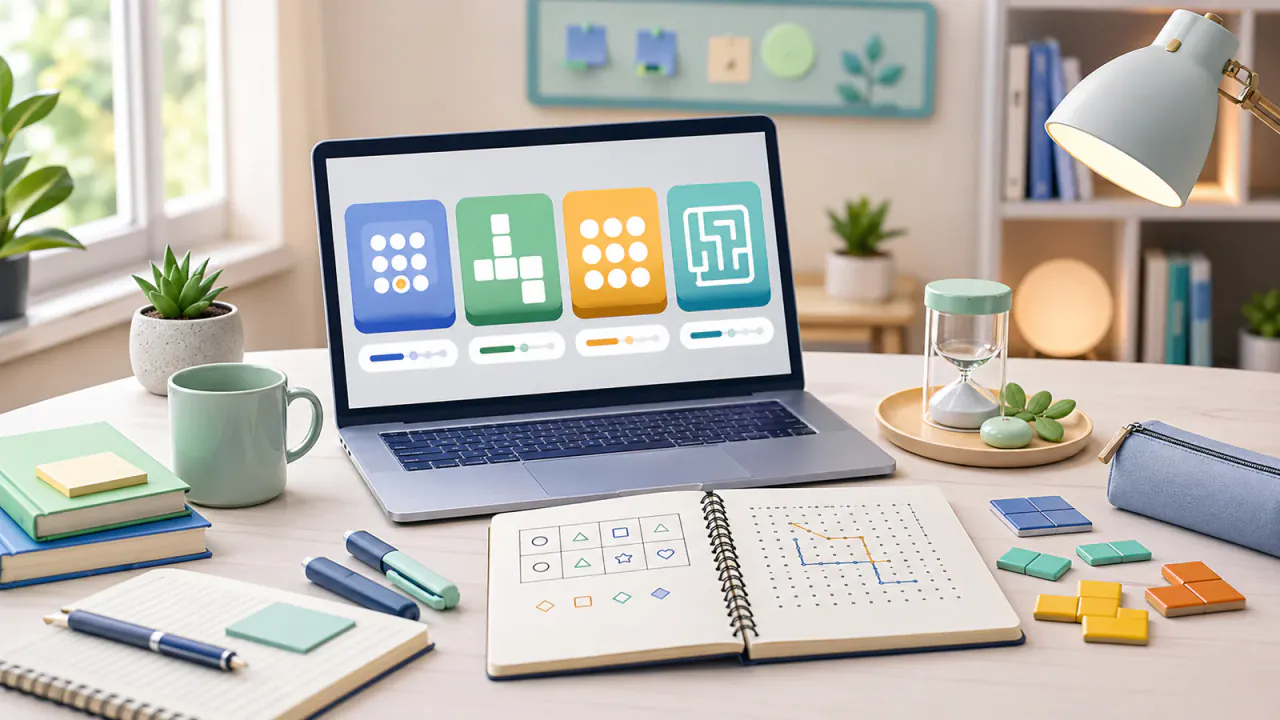
As the course load grows, many students look for a break that feels neither like running away nor like a punishment. The problem is familiar: after 50 to 90 minutes of work your head is full, but opening a social app “for 2 minutes” can easily turn into 25. On the other hand, pushing on without a breather often ends in passive reading, with a sense of being there… without really taking anything in.
Concentration games for students are useful precisely in that in-between space. The idea isn’t to “get smarter” in a few taps, and even less to promise any medical effect. The idea is simpler and more realistic: offer a structured micro-activity that is short, playful and has a clear ending, to reset your attention before you go back to the next session.
At Kognify, we talk about practice, challenge and consistency. No miracles. A light framework, easy-to-read games, and a method that respects your student schedule.
Why short breaks work better than vague ones
A vague break often looks like this: you leave a tough chapter, you “take a quick look” at your phone, you hop from one app to another, then you come back feeling you’ve lost the thread. Your brain has switched activity, but with no clear start or end.
A short break built around a game changes three things:
- The length is fixed: you know when it starts and when it ends.
- The goal is visible: hit a score, finish a level, cut down on errors.
- The feedback is immediate: you get a concrete result, then you stop.
This structure keeps time from slipping away. You’re not trying to perform at all costs; you’re trying to head back cleanly to your lectures, problem sets, past papers or revision notes.
The right format: 8 minutes, not 30
Between two sessions, the goal isn’t to start “a long game”. The most reliable format is often:
- 1 minute: a few quick breaths + a change of posture;
- 5 to 6 minutes: a concentration game;
- 1 minute: transition back (water, notebook, next task).
If you tend to overrun, drop to 6 minutes in total. If you’re very disciplined, 10 minutes is still a good upper limit.
Plan your break before you start studying: game chosen, length set, next chapter already written down. You greatly reduce the risk of an "endless break".
Which games to choose depending on the time of day
Not every game suits every break. The best choice depends on how tired you are and on the kind of session you’ve just finished.
1) After a dense session (technical course, maths, law)
Pick a simple visual vigilance or quick sorting format. You want to get your mind moving again without a pile of rules.
2) Before an analysis session (essay, summary, case study)
A short logic game can be a good fit: it makes you build a strategy quickly without draining your energy.
3) At the end of the day
Go for very short formats with no aggressive timer. The goal is to keep a pleasant ritual, not to end the day exhausted.
A practical method: the “Before / During / After” protocol
If you want a simple framework, use this protocol. It takes very little time and cuts down on routine slip-ups.
Before (30 seconds)
- write down the task that comes right after the break;
- decide the exact length (e.g. 8 minutes);
- put your phone on silent if you’re playing on a computer.
During (6 to 8 minutes)
- play just one format;
- keep a single goal: accuracy, pace or consistency;
- stop as soon as the alarm goes off, even if “you could do better”.
After (30 to 60 seconds)
- write one line: “back to studying at HH:MM”;
- drink some water;
- pick up the planned task, without negotiating with yourself.
This protocol may look basic, but that’s its strength: fewer decisions, so less friction.
Concrete examples of student routines
Library routine (morning)
- Session 1: 60 min of course material;
- Break 1: 8 min visual game;
- Session 2: 50 min of exercises;
- Break 2: 5-minute walk + water;
- Session 3: 45 min of active revision.
Exam routine (afternoon)
- Block 1: past papers (75 min);
- Break: 7 min logic game;
- Block 2: targeted corrections (45 min);
- Break: 6 min breathing + stretching;
- Block 3: memorization (30 min).
”Small time slots” routine (commutes / between classes)
- 10 to 15 minutes available;
- 1 micro-session of a game for 5 to 6 minutes;
- 1 quick review of flashcards right after.
What they have in common: the break isn’t isolated. It’s tied to the next session.
Common mistakes (and quick fixes)
Mistake 1: switching games at every break
You waste time deciding.
Fix: keep 2 “go-to” games for the week.
Mistake 2: confusing a break with a performance
You try to beat your record at all costs, then come back stressed.
Fix: set a neutral goal (“no rushing”) instead of a maximum score.
Mistake 3: not planning your return
Without a planned return, the break naturally overruns.
Fix: write down the next task before starting the break.
Mistake 4: overloading your evenings
As fatigue builds, long sessions stop being effective.
Fix: shorter micro-breaks and simple exercises.
Tracking your progress without overcomplicating it
No need to build a complex spreadsheet. Three indicators are enough:
- Consistency: the number of structured breaks you took during the week.
- Quick return: the actual time between the end of the game and getting back to work.
- Perceived comfort: a subjective 1-to-5 rating of how easily you refocused.
Within two weeks, you’ll quickly see whether your routine holds up. If consistency drops, shorten the length before giving up altogether.
How to fit this in during exam season
During intense revision periods, the danger isn’t a lack of motivation but poor energy management. Days are long, priorities shift and mental load climbs. Concentration games can stay useful as long as you respect two rules:
- the moderation rule: a game break must stay short and have a clear end;
- the continuity rule: every break must serve the session that follows.
In practice:
- avoid trying new games during exam week;
- stick with formats you already know;
- shorten your breaks after 8 p.m.;
- focus on how well you get back to work rather than on your score.
Related resources to build your routine
To vary formats while keeping a consistent approach:
- online concentration games
- selective attention online
- online attention games for kids
- mindfulness and focus online
- online recruitment tests
And to jump straight into a short session: go to Kognify’s games.
A simple 14-day plan
If you’re starting from scratch, here’s a realistic plan:
- Days 1 to 4: 1 structured game break per day (6 to 8 min).
- Days 5 to 8: 2 game breaks on long days.
- Days 9 to 12: alternate between a visual game and a short logic game.
- Days 13 to 14: adjust the length to how tired you actually feel.
Don’t aim for perfection. Aim for a system you can keep up even when the week gets complicated.
Key takeaways
Concentration games for students are above all a transition tool: they help you move from one study block to the next with a clearer head. The value doesn’t come from a spectacular promise, but from a simple sequence: a short break, a single goal, a clean return to work.
If you stick to this framework, your breaks become a way to stay organized rather than a source of distraction.
Adapting the method to your field of study
The same logic can work in very different contexts. In science subjects, game breaks are often useful between two blocks of problem-solving, so you come back and read the questions more carefully. In humanities, they can fit between text analysis and writing, to avoid feeling saturated with words. In law, medicine or economics, they mainly help break up long memorization sequences.
What matters isn’t the subject, but keeping a steady rhythm. If your timetable changes every week, keep at least one stable break routine. Even a minimal one reduces decision fatigue and makes it easier to get back into work.
FAQ
How long should a good game break between two sessions last?
Between 6 and 10 minutes is usually enough to switch off, play and get back to work without breaking your rhythm.
What kind of game should I choose while revising?
Go for simple games with clear rules and a quick ending: visual attention, short logic or sorting under constraint.
Should I play at every break?
No. Alternating between a game, a short walk and a drink of water often works better than repeating a single format.
How do I stop the break from turning into a long distraction?
Start a timer before you begin, set a single goal for the session and stop when the alarm goes off, even if the game isn’t perfect.