
Free online puzzle games: challenge your logic
A brain teaser is above all a promise: a moment when the solution suddenly appears after minutes of stubborn effort. That instant shift from "impossible" to "so obvious" — the aha moment — is one of the most satisfying intellectual experiences. Find the best online puzzle games on Kognify, free and without downloads.
What is a brain teaser?
A brain teaser is a problem whose solution is not immediately obvious and requires non-linear reasoning. Unlike classic school exercises, a well-designed brain teaser resists direct approaches. The solution often comes from an unexpected angle — this is precisely what we call insight, or the moment of illumination.
Psychologists distinguish two types of problem solving. analytical resolution, where we methodically break down the problem step by step. And resolution by insight, where the solution suddenly emerges after a period of apparent blockage. Puzzles are champions of this second mode: they deliberately block the analytical approach to force the brain to find a different perspective.
This special nature makes brain teasers both frustrating and extraordinarily satisfying. The resistance they offer is exactly what makes their resolution so rewarding. It is also why players who solve puzzles regularly develop a form of mental flexibility — the ability to abandon an ineffective approach and adopt another quickly.
The 5 big families of puzzles
The term "puzzle" covers an impressive variety of formats. Here are the five main categories that you will find in any serious puzzle collection.
Logic puzzles
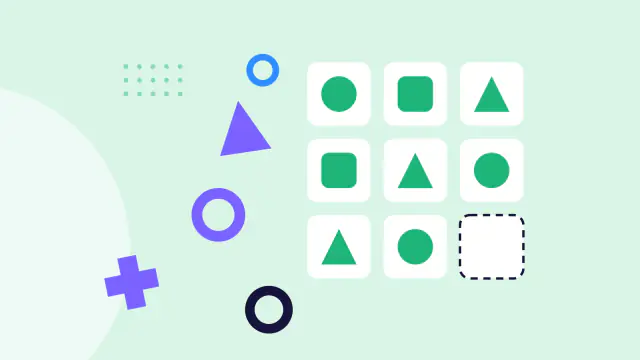
These puzzles rely on pure deduction. You have a set of clues and constraints from which you must identify a unique solution. Logical Deduction puzzles, "who lives in which house" problems, detective riddles — all belong to this family. The systematic elimination method is the key.
Space puzzles
The ability to visualize and mentally manipulate objects in space is key here. Tangrams, tile-sliding puzzles, and 3D mazes all require mentally simulating rotations and configurations before testing them. The 15 Puzzle and Sokoban-style games fall into this category.
Number puzzles
They exploit the properties of numbers and arithmetic relationships. Sudoku, Kakuro, Magic Squares, missing equations — all belong to this family. The satisfaction is particularly intense when the grid completes itself once the constraints are well identified.
Linguistic puzzles
Word games, anagrams, rebuses, intentional homophones — these puzzles exploit the richness and ambiguity of language. Kognify Hidden Links, Anagrams and Code Breaker partially belong to this family. They require thinking about words from multiple angles simultaneously.
Mechanical and physics puzzles
These are the classic physical puzzles: Rubik's Cube, intertwined metal puzzles, and dismantling puzzles. Their digital versions appear in manipulation games like Sokoban or virtual disassembly puzzles. They require both spatial visualization and precise action sequencing.
Our selection of free puzzles
These four free games from Kognify are real puzzles: they block, they resist, and they deliver that moment of intense satisfaction when the solution finally appears.
<div class="game-grid">
<a href="https://app.kognify-games.com/register" target="_blank" rel="noopener noreferrer" class="game-card">Premium puzzles to go further
Kognify's Premium catalog is full of more challenging puzzles, for players who want to go beyond the basics. These games combine several types of reasoning and offer difficulty levels that can challenge even the most experienced players.
<div class="game-grid">
<a href="https://app.kognify-games.com/register" target="_blank" rel="noopener noreferrer" class="game-card">The aha moment: why puzzles are so satisfying
The moment when the solution to a puzzle suddenly emerges — the aha moment or insight — is one of the most distinctive experiences of intellectual play. Neuroscience researchers have studied this phenomenon and the results are fascinating.
When an insight solution occurs, the brain releases a significantly greater dose of dopamine than during a classic analytical solution. This reward peak is comparable to that observed when obtaining a physical reward. The brain literally rewards creative discovery.
In addition, the solutions found by insight are better memorized than those obtained by systematic calculation. The positive emotion associated with the discovery acts as a mnemonic marker which consolidates the memory of the solution. That's why you never forget how you solved a particularly difficult puzzle.
Finally, regularly solving puzzles develops cognitive flexibility — the ability to abandon one ineffective strategy and adopt another quickly. This ability is transversal and applies to many problem-solving situations in daily and professional life.
<div class="tip-box">- Take a break: If you've been stuck for more than 3 minutes, put the puzzle down and come back 5 minutes later. Changing context often unlocks the solution.
- Restate the problem: Describe the situation out loud, as if you were explaining it to someone. This verbalization sometimes activates unexpected connections.
- Reset everything: sometimes a false lead started early blocks all solutions. Don’t hesitate to start from the beginning with fresh eyes.
- Question your assumptions: identify the implicit rules you have unconsciously set for yourself — they are often the source of the blockage.
- Start with the strongest constraints: the elements with the fewest possibilities are the best starting points.
Frequently asked questions
<details class="faq-item">Among Kognify's free games, several are puzzles in their own right: Code Breaker, Logic Deduction, Hidden Links and Mental Math. All are accessible with no sign-up, directly from your browser or the Android application.
<details class="faq-item">A jigsaw puzzle usually refers to a physical assembly game (such as a 1,000-piece puzzle). A brain teaser is broader: it is any problem that requires a non-obvious solution and creative reasoning. All jigsaws can be brain teasers, but not all brain teasers are jigsaw assemblies.
<details class="faq-item">The key is regularity. Playing daily, even for 10-15 minutes, exposes the brain to recurring patterns. Vary the types of puzzles (logical, numerical, spatial) to encourage different forms of reasoning. Agree to block: resistance is precisely what makes the exercise interesting.
<details class="faq-item">Absolutely. Puzzles are recommended for all ages. For seniors, they are a stimulating form of intellectual play. Kognify offers progressive difficulty levels suitable for all audiences, from beginner to expert player, with 80+ games in 6 different categories.
<details class="faq-item">It's the "fixity effect": your brain is locked into a particular approach and refuses to change. The solution: put down the puzzle, do something else for 5 minutes, then come back. This change in context often allows you to see a completely different approach that solves the problem immediately.
<div class="cta-box">Logic, deduction, spatial — dozens of puzzles await you on Kognify. Free, no download.
🧠 Start playing9 free demos without registration · Free 7-day Premium trial on request