
Free online vocabulary tests are useful when you want a quick benchmark, especially if you want to check your level without a complex signup. In a few minutes, they can show your strong points and the areas to review.
But not all tests measure the same thing. A “good” score on one platform can become “average” on another, simply because questions, time limits, and scoring methods change.
Which vocabulary test formats are the most common?
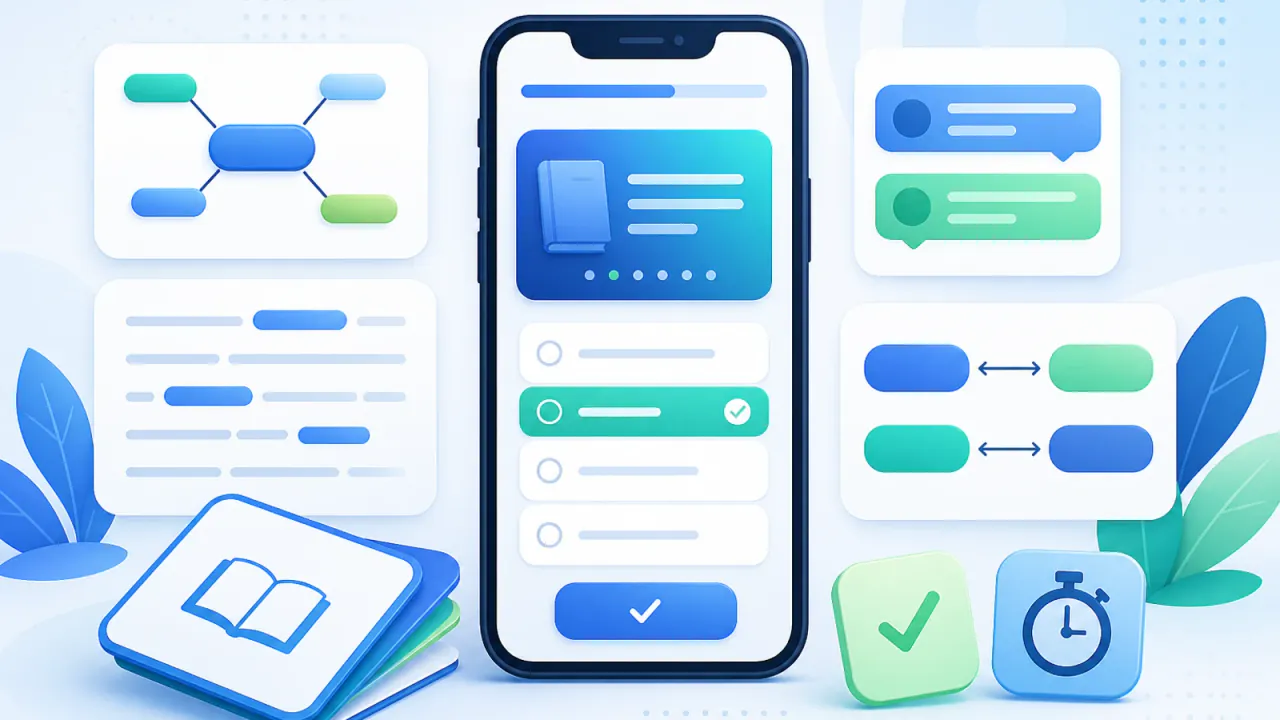
The most common format is still multiple choice: one question, several answers, one correct option. This format is practical because it is fast to grade and easy to automate.
You will also find common variants:
- fill-in-the-blank exercises in a sentence;
- word-definition matching;
- synonyms and antonyms;
- sorting words by lexical field;
- short timed mini-tests.
These formats do not all serve the same goal. A fill-in exercise tests context, while multiple-choice isolates word meaning more directly. Word-definition matching mainly checks semantic precision.
If you compare two tests, check format and duration first before comparing scores. Otherwise, you are often comparing different things.
Common limits of free tests
Free tests are useful, but they come with structural limits.
First limit: lexical coverage. Many tests use a limited word sample. So you can get a high score on a narrow selection that does not represent your full real usage.
Second limit: scoring variability. Platforms do not all use the same scale. Some label a level as “advanced” with internal criteria that are not equivalent to an official certification.
Third limit: the format effect. Someone can be very comfortable with synonyms and weaker with context words, or the reverse. The global score can hide that detail.
Fourth limit: the timer effect. Very fast tests combine word knowledge and reading speed. If you play on mobile with interruptions, the result can be penalized without reflecting your real level.
Fifth limit: stability. Repeating the same test with a new set of questions can change the score, especially when the question bank is small.
How to use a free test without misreading your score
The simplest way is to use tests as a guidance tool, not as a final verdict.
Recommended approach:
- take two different tests in the same week;
- note recurring themes (synonyms, definitions, context);
- focus on recurring errors rather than the final percentage;
- then plan a targeted practice routine.
This method avoids the “I am good or bad” trap based on one score.
If your goal is an exam or an academic file, keep in mind that a free test does not replace an official assessment. For example, CEFR scales are based on multiple skills (reading, listening, production), not only a vocabulary quiz.
Practical alternatives to vocabulary tests
When you want steady progress, game formats are often easier to maintain.
Useful alternatives:
- Online vocabulary games: good for varying mechanics;
- Online definition games: useful for precision of meaning;
- Synonym and antonym games: good for nuances;
- Online etymology games: useful for learning by word families;
- Wordle in French: effective for very short sessions.
The advantage of these formats: immediate feedback, natural repetition, and more motivating progress than one-off testing.
A simple routine: test + game in 12 minutes
You can combine check-in and practice in one session:
- 3 minutes: mini vocabulary test (multiple-choice or fill in);
- 5 minutes: definition or synonym game;
- 4 minutes: letter game or association game.
Session goal:
- identify one error type;
- correct that error type right away;
- end with a feeling of progress, not frustration.
On Kognify, you can build this flow from the games page and switch easily between language formats.
Which signals should you track for real progress?
Instead of aiming for one score, track three simple indicators:
- error rate on the same format;
- average time to answer cleanly;
- number of new words retained after 24 hours.
These three indicators are more robust than one isolated “final score.”
If you track this for 2 to 3 weeks, you quickly see which format helps you most. You can then reduce repetitive testing and increase useful game practice.
In practice: what should you choose in 2026?
If you want a starting point without paying:
- use a short free test to benchmark yourself;
- avoid over-interpreting one result;
- move quickly to game-based practice formats;
- return to tests only to check the trend.
This “occasional test + game routine” logic is easier to maintain than a chain of isolated tests.
It also matches the real purpose of a free tool: guide you quickly, then help you practice consistently.
FAQ
What is the most common vocabulary test format?
The most common format is multiple-choice. You will also find fill-in-the-blank exercises, word-definition matching, synonym-antonym tasks, and short timed mini-tests.
Can a free online test replace a certification?
No. A free test is mainly useful to benchmark your level and guide practice. For an official application, you still need a recognized certification based on your goal.
Why do results vary from one site to another?
Difficulty level, question bank, allowed time, and scoring method are not standardized across platforms. Two tests can therefore produce different levels.
What is a good alternative to tests for regular progress?
Vocabulary games with instant feedback are a strong alternative: definitions, synonyms, associations, and letter games. They are easier to keep in short sessions.
How much time should a vocabulary session take?
Between 8 and 12 minutes is enough for a useful session. Regularity and format variety matter more than one long occasional session.