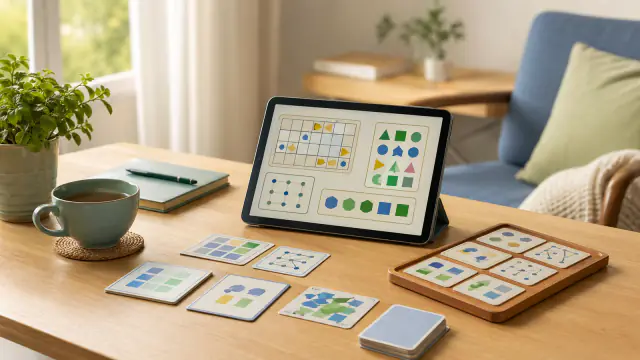


Complete guide to online brain training in 2026
Online brain training is above all a structured game format: you follow a series of short challenges, you track your scores, then you adjust your routine to keep pace without saturating yourself. The right choice is not the loudest platform in marketing, but the one that allows you to play regularly with varied mechanics. This guide helps you compare options, avoid vague promises and build a simple, sustainable and motivating practice.
Key points to remember
- Start with a light routine: 10 to 20 minutes, 4 days a week.
- Vary the categories: memory, logic, attention, calculation, speed, language.
- Use a mix of timed games and sessions without a timer.
- Follow the trend over several days, not just one part.
- Prioritize accessibility: clear interface, quick launch, minimal friction.
Why this guide is different from a simple comparison
A classic comparison classifies the platforms on the surface: number of games, price, design, reviews. It’s useful, but incomplete. In practice, the real criterion is your ability to maintain a real routine over several weeks. A library of 100 mini-games is useless if you give up after four days, or if each session requires too much manipulation.
This guide therefore takes a use-oriented approach. We will look at the game mechanics, the mental load of the interface, the ideal frequency, the difficulty curve, mobile readability, the mode without a timer, the quality of statistical monitoring and the progression logic. It is this combination that determines whether your practice remains enjoyable.
For a broader overview of the free offers, you can also consult the dedicated comparison free online brain training. And if you prefer to start with very concrete formats, the online brain games page offers entries by type of challenge.
The 6 families of games that structure brain training
A good program does not rely on a single mechanic. The benefit of online brain training comes from the mix. Here are the six most useful families for building balanced sessions.
1) Memory
Here we find visual pairs, sequences, associations and short recall variants. This is the most intuitive family, especially with formats like free online memory games or Kim game-type variants. The key point is variety: always doing the same format quickly reduces engagement.
2) Be careful
This family covers vigilance, selective concentration and distractor management. The formats are often quick and require clear visual reading. To dig into this topic, look at online concentration games and dedicated attention tests.
3) Logic
Deduction puzzles, sequences, and rule constraints provide depth. This category fits well into routines without a timer, especially at the beginning. You will find examples on online logic games and in the puzzle articles.
4) CalculationThe mental arithmetic involved works well when the difficulty is progressive and the feedback is immediate. The best formats offer a simple starting level then a gradual increase. See free online mental arithmetic games to get started.
5) Speed
This family emphasizes tempo: short decisions, rapid pattern recognition, dynamic sequencing. It must remain dosed so as not to create unnecessary fatigue. You can compare formats on online reflex speed games before adding timed tests.
6) Language
Anagrams, vocabulary, lexical associations, semantic categories: these games bring a different breath of fresh air to a routine. They are useful when you want to maintain a level of challenge without imposing too high a pace. See free online anagrams for simple entry.
Comparison table of platform formats
The table below does not compare specific brands, but product logics. This is more useful for choosing a frame compatible with your daily life.
| Format | Highlights | Frequent limits | Adapted profile | Friction level |
|---|---|---|---|---|
| Website without installation | Immediate start, multi-device access, simple sharing | Some platforms limit advanced tracking | People who want to play quickly, without constraints | Low |
| Dedicated mobile application | Notifications, more guided route, scripted progression | Longer download, storage, onboarding | Users who like supervised routines | Medium |
| Very large freemium catalog | Large selection of mini-games, quick discovery | Restricted access, interruptions, aggressive premium course | Curious who test a lot of formats | Medium to high |
| Guided session oriented platform | Clear structure, weekly consistency, readable indicators | Less extreme customization | Profiles who want regular practice | Low to medium |
The best choice is one that reduces friction between intention and action. If you have to go through multiple screens before playing, your stickiness rate drops. If, on the other hand, you can launch a session in a few seconds, you maintain your momentum.
If you want to go straight to practice, start a session on the games page Kognify then come back to this guide to refine your routine.
Choose a platform according to your real profile
We often overestimate the initial level of motivation. The right strategy is to choose a format that is slightly simpler than you think you can fit.
Profile A: busy schedule
If your days are busy, choose short, prepared and repeatable sessions. A web format with quick recovery is generally more robust than an application requiring several navigation screens. Aim for 4 12-minute sessions rather than one big weekly session.
Profile B: curious player who likes to explore
Do you like testing various mechanics? Set a framework: 70% usual games, 30% new. This avoids the infinite collection effect where you try everything without stabilizing your routine.
Profile C: search for comfort and regularityPrioritize readability, element size, clear feedback and timeless mode. The goal is to reduce interface fatigue. The memory, logic and language categories are often the most comfortable for maintaining a stable pace.
Profile D: competitive, score-oriented
Keep a core of fixed games to track your progress, but keep at least one category rotating each week. Without rotation, you risk over-specializing your habits and losing the overall interest of the practice.
An important point: no platform is perfect for all profiles. It’s normal. What matters is the compatibility between your real context and the proposed game structure.
Concrete method: build your weekly routine
The simplest is to apply a six-step method, the same logic as in the HowTo markup in this guide.
Step 1: Block a realistic slot
Choose fixed days, ideally linked to an existing habit: after morning coffee, during a lunch break, or at the end of the day before turning off the screens.
Step 2: limit your selection to 3 categories
A triptych of memory + logic + attention works very well to start. You can add calculation, speed or language later.
Step 3: stabilize the difficulty over 7 days
During the first week, avoid changing any settings. Keep a consistent level to create reliable benchmarks.
Step 4: alternate tempo and comfort
For example: two sessions without a timer, two timed sessions. This mix avoids monotony and limits fatigue.
Step 5: Write down simple landmarks
Note three pieces of data: number of sessions, median score on your main games, feeling of fluidity. No need for a complex table.
Step 6: Adjust one variable at a time
At the end of the week, only change one parameter: duration, difficulty or secondary category. You will more quickly identify what works.
This method also applies very well if you are exploring one-off tests like an online Stroop test or other visual assessments, as long as you keep a stable core of games.
Frequent errors that break regularity
Mistake 1: aiming too high from the start
Starting at 30 minutes a day may seem motivating, but it’s rarely sustainable. A routine that is too ambitious quickly collapses. A moderate base is sturdier.
Mistake 2: changing games every session
Constant exploration gives a feeling of novelty, but prevents building benchmarks. Keep 2-3 sets fixed, then add 1 set of rotation.
Mistake 3: confusing a one-off peak with progression
An isolated record is not a trend. Instead, observe the results over 2 to 3 weeks.
Mistake 4: ignoring mobile convenience
If the game is only playable on the big screen, you will play less often. Check clarity on smartphone.
Mistake 5: spreading yourself across too many platforms
Multiplying tools fragments your benchmarks. Choose a main base and keep the others as backup.
To avoid this dispersion, you can structure your course by theme with dedicated pages, such as online brain exercises and application comparisons.
Measure your results without falling into over-interpretation
Tracking is useful if it remains readable. Here is a simple framework.
KPI 1: weekly frequencyThis is the main indicator. If you maintain your target frequency, the routine is healthy.
KPI 2: median score
Use the median score, not the best score. The median better represents your usual level.
KPI 3: stability by category
Compare memory, logic, attention, calculation, speed and language separately. Each category evolves differently.
KPI 4: perceived comfort
Evaluate your feelings after session: too tense, fluid, monotonous, dynamic. This qualitative signal helps to adjust the format.
If a category becomes too repetitive, temporarily replace it with an equivalent from the same game family, for example switching from logic puzzles to logic problem-solving games, or another visual variation.
Recommended route on Kognify: from beginner to regular
Here is a concrete proposal over four weeks, oriented towards pleasure and maintaining the rhythm.
Week 1: installation of the routine
Objective: 4 sessions of 10 to 12 minutes.
Recommended mix: 2 memory games, 1 logic, 1 attention.
Week 2: consolidation
Objective: maintain the frequency, slightly increase the challenge on a single game.
Possible addition: a calculation or language mini-game.
Week 3: controlled diversification
Objective: keep 70% stable core, 30% new.
Useful format: alternate chrono mode and mode without chrono.
Week 4: adjustment and anchoring
Objective: analyze your tendencies, remove what overloads, strengthen what motivates.
Key action: prepare the next cycle with the same structure, not with a total break.
If you want to go deeper into the memory component, continue with the complete guide to online memory games. It is the natural neighbor guide of this one.
FAQ about online brain training
Is online brain training reserved for people who are very comfortable with games?
No. Modern interfaces are designed for very varied profiles. The most important thing is to choose a platform that is easy to launch and start with a comfortable difficulty level.
What session duration is most realistic on a daily basis?
A range of 10 to 20 minutes works well in most planners. Weekly regularity is more important than an occasional long session.
Should you play with or without a timer?
The two modes complement each other. The timer energizes the sessions, while the timeless mode makes it easier to learn the mechanics and read the rules.
How to avoid getting tired after a few days?
Keep a stable core of games, then introduce a small weekly rotation. Too much variety at once makes the routine unstable.
What indicators should you follow to see your game progress?
Practice frequency, score median, and stability by category are the most useful. Avoid judging your progress on an isolated record.
Is online brain training suitable for seniors?
Yes, if the platform offers clear navigation, good contrast, short sessions and a timeless mode. Comfort of use remains a priority.
Can we practice without installing an application?
Yes. Web platforms allow you to play directly on a browser, which simplifies access on mobile as well as on computer.
Conclusion: the best strategy remains the most tenableThe best guide, the best comparison and the best platform do not replace a realistic routine. If you keep a light framework, a clear selection of games and simple monitoring, your practice will remain active over time.
Start today with a short session on Kognify Games, then keep this guide as a reference to refine your choices week by week. You can also leave from home Kognify if you want to review all of the available routes.