

Online logic games: the essentials in 2026
Sudoku, nonograms, deductions — online logic games keep attracting players because they are complete games of reasoning. This guide covers the main logic families, how each one works, and a selection of the best free games you can play directly in your browser without installing anything.
Why are logic games so compelling?
A good logic game is like a well-written mystery: it sets a clear problem, provides all necessary rules, and gives a deep sense of completion when the solution appears. Unlike action games that rely mostly on reflexes, logic games are fully under the player’s control — every move is a deliberate piece of reasoning.
This sense of control explains much of their cross-generational appeal. A 10-year-old and a 60-year-old can both enjoy Sudoku or a nonogram at their own level. Online logic games add browser convenience: no installation, no scratch paper, and endless generated grids.
In 2026, free online logic games cover dozens of formats. Here are the six major families to know.
The 6 major logic families
Numerical grids
Sudoku is the archetype: fill a grid with numbers while respecting non-repetition constraints. Kakuro is the arithmetic variant — each row and column must total a target value. These games test constraint-based deduction and systematic patience. They exist in classic form as well as reduced formats (4×4, 6×6) for shorter sessions.
Pure deduction
A set of clues describes a situation (who wears which color, who lives where), and you rebuild the full solution by elimination. These are sometimes called Einstein Puzzles or logic-grid puzzles. Logic Deduction on Kognify follows this format with progressive levels from beginner to advanced.
Logic circuits
Logical gates (AND, OR, NOT, XOR) are arranged in a network and you must activate the right switches to produce a target output signal. This format is especially appealing if you enjoy computing basics or electronics, but it remains accessible to beginners with a clear progression.
Spatial puzzles
Nonograms (also called Picross), Lights Out, and Sliding Puzzle rely on spatial visualization and positional logic. In a nonogram, edge clues tell you how to fill cells and reveal a hidden image. In Lights Out, activating one light turns others off, and you must find the right sequence to clear the board.
Sequences and patterns
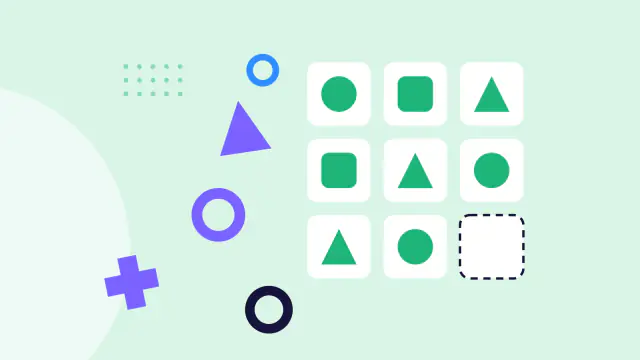
Identify the rule behind symbols, shapes, or numbers, then apply it to complete the sequence. This is one of the game forms closest to classic IQ-style pattern tests. Matrices on Kognify offers 3×3 symbolic pattern grids inspired by Raven-style matrix questions.
Connection games
Grouping elements under a hidden theme and spotting links between seemingly unrelated terms are key in these category-based games. This is associative logic at work. Hidden Links is a strong example: identify four groups of four words while avoiding crafted traps.
Selection of 9 logic games on Kognify
Here is a complete selection of Kognify logic games, from free to Premium.
How to improve your logic
Logic develops through repeated exposure to different problems. The common myth is that it is a fixed talent. In practice, progress comes from regular, structured play and reflective thinking.
- Start with one game type and master it before exploring others; depth beats dispersion.
- Review mistakes: in logic, a wrong answer usually reveals a reasoning gap, not a question of luck.
- Track constraints: in Sudoku or deduction, noting what is impossible is as useful as noting what is certain.
- Rotate game types: each family stresses different mechanisms, and this mix improves overall reasoning.
- Play first without timer on Kognify (Premium), then introduce timing gradually when comfortable.
- Repeat difficult levels: a failed level is strong training — replay it once it is fresh in memory.
It is also useful to understand that formal logic and gameplay logic are not identical. A game like Lights Out relies on binary operations, but you do not need that technical background to play efficiently. Intuition develops naturally through repetition. That is what quality logic games do: they transform abstract reasoning into daily reflex through play.