

Online logic games for high school students: prepare for admissions tests
Admissions in France and many international pathways include a logic component. QCM reasoning, figure sequences, analogies, and syllogisms all trainable skills. Online logic games make daily preparation simple and consistent. This guide explains what different exams evaluate and which Kognify games align with each test type.
Logic and admissions: what is evaluated
Logic appears across many selection processes, but in different forms depending on the track. The first step is understanding what each exam actually measures.
The four logic skills most often tested
Across exam formats, four core reasoning categories appear repeatedly. Mapping your strengths and gaps to these categories helps you train with purpose.
1. Deductive reasoning
This is the core skill: deriving a necessary conclusion from assumptions. In plain terms: “If A then B; A is true; therefore B is true.” This is the classic syllogistic model. In admissions tests, it appears as proposition chains and multiple-choice elimination.
2. Analogies and figure series
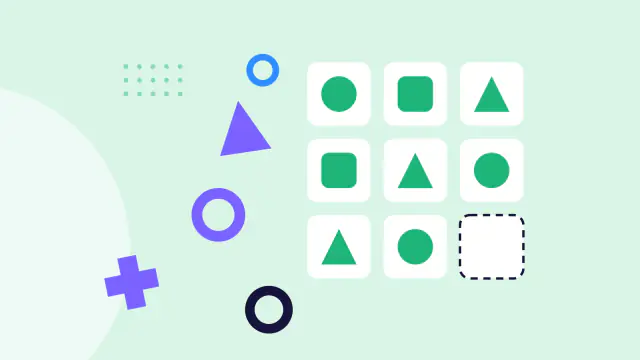
Analogies (“A is to B as C is to ?”) test relational thinking: identify the rule linking terms and transfer it to new objects. Figure series tasks in TAGE-MAGE and psychometric tests require detecting regularity across shapes, colors, or positions.
3. Propositional logic
Propositional logic checks your comfort with statements connected by AND, OR, NOT, IF...THEN, and IF AND ONLY IF. In exam terms, this appears as “Given P implies Q and Q is false, what can be concluded about P?” style statements.
4. Constraint-based problem solving
“Five people sit around a table with constraints” or “Who committed the act, knowing X, Y, Z?” are examples of this format. You must work from incomplete information and progress through systematic elimination.
How Kognify games map to these skills
Logic Deduction: the practical exam base
Logic Deduction is the best fit for admissions-style questions. Each puzzle provides partial clues and constraints, then requires progression by systematic elimination and chained deduction. This mirrors the structure of many selective QCM logic questions.
Code Breaker: hypothesis and validation cycles
Code Breaker trains the same cycle used in many logic tasks: propose a hypothesis, test it, read the result, then refine it. It also reinforces uncertainty handling by tracking knowns and unknowns until the situation is resolved.
High school strategy for logic sections
Use elimination, not guessing
A common pitfall is rushed guessing. Most logic questions are deterministic: if you cannot deduce the answer, you may have missed a clue or an elimination step. Return to the previous step and recover structure before retrying.
Time strategy: avoid getting blocked
In timed tests, time is a real constraint. An effective rule is to not spend more than 2 minutes on one question before marking it and moving on. Returning later often gives better perspective and accuracy.
Timed Kognify sessions help you build decisions under pressure. Use timed mode for performance simulation, and use Zen mode when learning concepts the first time.
Watch for common logic traps
Some reasoning feels obvious but is logically invalid. Affirming the consequent (“If A then B; B is true; therefore A”) is a classic error. So is denying the antecedent. Repeated practice in deduction games makes these traps easier to spot in exam conditions.
Our 6 logic games for students
When to start and how often to practice
Timing matters. A practical rhythm of 15 minutes daily over 6 to 8 weeks helps you build familiarity with standardized logic formats. A slower, consistent start is often better than an intense last-minute push.
A recommended path is to start 8 weeks before the exam. The first 4 weeks build fluency with each game type. The next 4 weeks add timed simulations: short high-focus sessions, mixed question formats, and deliberate switching between game families.
For students without a near-term exam, three shorter sessions per week (10 to 15 minutes) can help maintain routine over the long term.
- Weeks 1–2 — Core mechanics: play Logic Deduction and Code Breaker without timer (or with Zen mode). Goal: master mechanics, not speed. Review errors after each session.
- Weeks 3–4 — Build your method: identify weak areas (analogies, figure series, conditional logic) and focus sessions on them. Add timing gradually. Aim for 80% accuracy before increasing speed.
- Week 5 — Exam simulation: 20–25 minute timed sessions with mixed game types. Practice marking difficult questions and returning later. Review mistakes at end.
- Week 6 — Consolidation: reduce intensity to 10–15 minutes per day. Replay mastered game types to reinforce confidence. Avoid overloading the day before the exam.
- Optional support: free games (Logic Deduction, Code Breaker, Hidden Links) cover essentials. If your exam uses abstract figure tasks (TAGE-MAGE style), Matrices is the most direct extension.
Frequently asked questions
Which admissions exams test logic for high school students?
How do Kognify games support admissions-style logic practice?
How early should logic training start before exams?
Can online games help with logic exam practice?
How do I manage time in logic questions?
Logic Deduction, Code Breaker, Hidden Links — three free games for daily prep without download.
🔭 Start practice →Free · Admissions-focused tracks · No mandatory registration