
Nonogram online: rules, strategies, and where to play free
Nonogram is one of the most satisfying logic grid games: each solved cell reveals more of a hidden picture until the full image appears. Also known as picross or griddler, it is easy to start and deeply rewarding to master. Here is a practical guide to learn the rules and solve puzzles faster.
What is a nonogram?
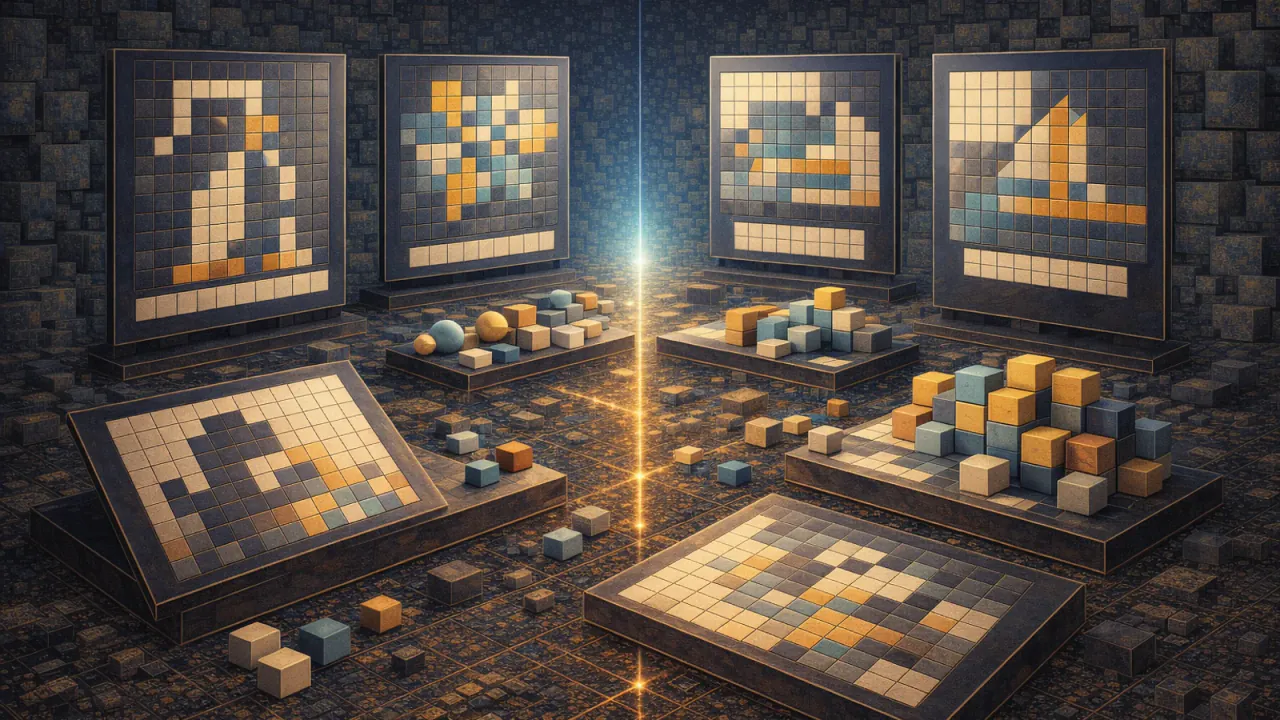
A nonogram is a logic puzzle played on a square grid. You fill or leave blank each cell based on number clues shown for every row and column. When the clues are solved correctly, they reveal a hidden pixel-style image.
You may see this puzzle under different names:
- Nonogram - generic name
- Picross - Nintendo branded series
- Griddler - common in many English puzzle collections
- Paint by numbers - descriptive nickname
The core idea is always the same: use logic constraints to reveal a picture, one deduction at a time.
Nonogram rules explained simply
The grid: each puzzle is a matrix (for example 5x5, 10x10, or 15x15). Every cell is either filled or empty.
The clues: a clue like "3" means one block of 3 consecutive filled cells. A clue like "2 1" means a block of 2, then at least one empty cell, then a block of 1, in that order.
Here is a concrete 5x5 example:
Left clues describe row blocks. Top clues describe column blocks.
5 strategies to solve nonograms faster
-
Use overlap first
If a clue is large relative to the line length, some cells must be filled no matter where the block starts. Mark those guaranteed overlaps immediately.
-
Mark impossible starts
Use clue spacing limits to mark cells that cannot belong to any block. Empty marks are as valuable as filled marks.
-
Prioritize constrained lines
When clue totals plus minimum gaps equal the full line length, placement is fixed. Solve those rows or columns early.
-
Cross-check every update
After filling or clearing one cell, immediately check both its row and column. Nonogram progress comes from fast back-and-forth deduction.
-
Avoid random guessing
If you are stuck, scan for overlooked overlaps, spacing constraints, and completed lines. Good puzzle flow is deduction-driven.
- Start with 5x5 grids: fast rounds help you internalize clue reading.
- Then move to 10x10: enough complexity for real pattern practice.
- Always mark empty cells: it prevents repeated mistakes later.
- Look at biggest clues first: they usually unlock the board quicker.
Play nonogram and similar logic games on Kognify
Kognify includes nonogram in its puzzle catalog, with progressive levels and optional hint support for blocked moments.
If you enjoy logic grid games, you may also like: