

Online associative memory games: create links to remember
You remember a face but forget the name. You can recognize a foreign word but cannot retrieve it instantly. This gap is not a failure of ability, it is associative memory needing more structure. The good news is that associative memory is one of the easiest forms to practice through games. This guide explains how associations are built in the brain, and which free Kognify games you can use.
What is associative memory?
Associative memory is the ability to remember links between two or more elements. A name and a face. A word and its meaning. An image and a sound. A date and an event. Unlike isolated memorization (like repeating a list of numbers without context), associative encoding uses the brain's tendency to connect information.
This memory type is central to everyday life. Recognizing a neighbor, remembering where you placed your keys, learning a new colleague's name, or navigating a familiar city all rely on long-term memory associations. It is also a core principle behind many advanced memorization strategies.
Unlike serial memory (memorizing a fixed sequence), associative memory is bidirectional: if you know A you can recall B, and if you see B you can retrieve A. That bidirectional access makes recall more resilient in real situations.
How the hippocampus builds associations
The hippocampus — the seahorse-shaped structure in the medial temporal lobe — is the brain region most directly involved in forming new associative memories. It helps link representations stored across the cortex.
When you meet a new pair (for example, a face + a name), the hippocampus creates stronger links with repeated exposure. The stronger the emotional or contextual context, the faster the encoding becomes.
A major difference from serial encoding is interference resistance. Sequence lists are more vulnerable to proactive and retroactive interference. Associative pairs, when encoded in a unique context, tend to be easier to keep separate.
Associative vs serial encoding: why pairs win
Imagine two ways to learn ten European capitals. First: recite the list in order — Paris, Madrid, Rome, Berlin… Second: link each capital to a mental image — the Eiffel Tower for Paris, a matador for Madrid, the Colosseum for Rome.
In many free-recall tests 24 hours later, associative encoding is often more effective than pure serial repetition. Each link creates extra retrieval hooks. The more hooks, the easier the recall.
Serial position effects (better memory of start and end) do not impact associative pairs in the same way because each pair has its own context. That is why students often progress faster when learning vocabulary through images or context-rich phrases instead of word-only lists.
PAO: linking to remember 50 items in 20 minutes
The PAO (Person–Action–Object) method is one of the most powerful association techniques used in competitive memory circles. It creates a vivid triple mental image for each item: a person, an action, and an object.
For example, to encode the pair "sun–crescent," you might imagine Einstein (person) taking a big bite (action) of a golden crescent that shines like the sun (object). The image is absurd, colorful, dynamic — all great triggers for associative encoding.
This is the same associative logic behind memory games: each Memory Classic round asks you to create a mental map of where pairs are positioned, which is a form of implicit visual association.
4 association types in Kognify
Memory Classic: the classic visual association game
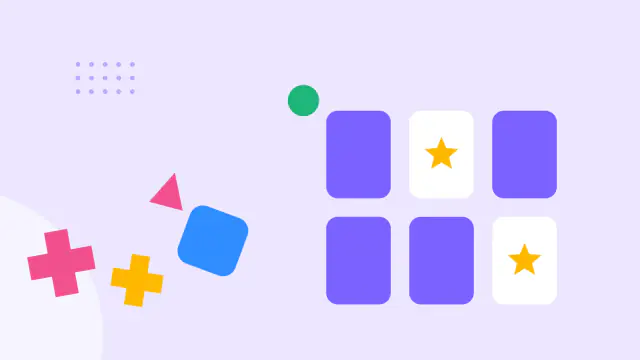
Pair-matching may be one of the oldest associative memory exercises in game history. Its mechanics are simple: flip two cards, remember their positions, form pairs. Behind that simplicity is a deep challenge for visuospatial associative memory — the same mechanism used when finding where you parked your car or where your keys are stored.
False Recognition: resisting interference
This less-known game is one of the most sophisticated associative exercises. You see a stream of items and must separate those you truly saw from close look-alikes. This trains your resistance to retroactive interference — confusion between similar associations, a frequent source of everyday forgetting.
How associations accelerate foreign-vocabulary learning
Learning a new language is fundamentally an associative memory task at scale. Each new word combines at least two elements: sound and meaning. A practical functional vocabulary of 10,000 to 20,000 words is essentially that many links to build.
Kognify can support this in two ways. Directly, through Synonyms Sprint (which reinforces lexical networks) and Missing Word (which practices context-based completion). Indirectly, by training general associative mechanisms: faster pairing, stronger distractor resistance, indexed recall.
Research on vocabulary strategies consistently shows better recall when words are practiced with images or phrase context rather than rote list repetition. Memory games reproduce this dynamic in an engaging, low-pressure format.
Our 5 free associative memory games
- Step 1 — Pick 10 anchor people: choose personalities you already know well (celebrities, fictional characters, friends). Each one will anchor a segment of your list.
- Step 2 — Build an unusual image: for each pair to remember, imagine your anchor person doing a playful action with the target object. The more vivid, the better it sticks.
- Step 3 — Visualize for 3 seconds: pause briefly and hold the image clearly in your mind before moving to the next pair.
- Step 4 — Test immediately: after encoding, try recalling pairs after 5 minutes without looking at the list. Each successful retrieval strengthens your association.
- Step 5 — Review at Day 1 and Day 7: spacing reinforces long-term retention. Two short reviews at the right times are usually enough.
Frequently asked questions
What is associative memory?
Why are pairs easier to remember than lists?
Which Kognify games train associative memory?
How does PAO work for learning associations?
How do association games help with foreign language learning?
Memory Classic, Hidden Links, Synonyms Sprint — 5 free games to practice associations without downloading.
🧠 Play for free →No download required · Works on mobile, tablet, and desktop