

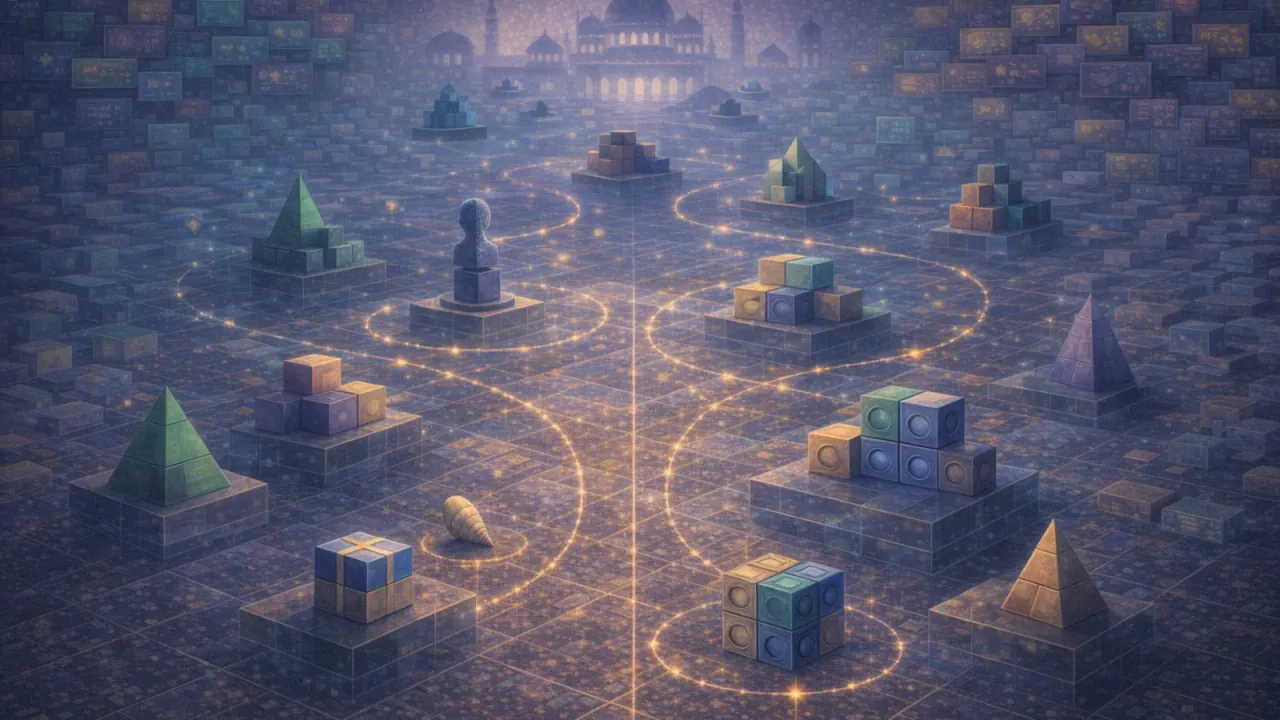
Online spatial memory games: positions and spaces
Remember where you left your keys, find your car in a parking lot, or orient yourself in an unfamiliar city — all of this relies on spatial memory, which is distinct from visual memory. This guide explains how it works, how loci methods help, and which games can be used to practice it.
Spatial memory and visual memory: two different systems
It is common to confuse visual and spatial memory. Yet they involve distinct brain systems and answer different questions. Visual memory answers "What did I see?" Spatial memory answers "Where was it?" and "How do I get there?"
A concrete example: if you see a 4×4 grid with 8 hidden card pairs, then search for the pairs, both systems are used. Visual memory tracks what each card looks like; spatial memory tracks where it is in the grid. The strongest players in Memory Classic often master both, while some excel mainly in positional consistency.
Spatial memory is body-based. It builds mental maps that include positions, distances, orientations, and relationships between places. This makes it very practical for everyday orientation and organization.
It is also often more durable than purely verbal memory. People may forget word lists but still remember the layout of a home they visited as a child, or find their way through a familiar city after many years.
The hippocampus: biological GPS
At the heart of spatial memory is the hippocampus, a seahorse-shaped structure in the medial temporal lobe. Following John O'Keefe's 1971 discovery of place cells and his Nobel-recognized work in 2014, neuroscience has mapped this structure's role in navigation.
Place cells activate in specific contexts: one cell fires near a familiar corner, another by a doorway. Together they form a continuous spatial representation. Familiarity increases precision and stability in this map.
Studies of London black cab trainees showed posterior hippocampal volume differences consistent with years of map-heavy navigation. As experience grows, the brain can show measurable adaptation in these spatial circuits.
4 forms of spatial memory
1. Allocentric memory (world map)
Build a map independent of one’s own position: "the library is north of the town hall." This is the most robust form because it supports navigation even when your body orientation changes.
2. Egocentric memory (body-centered)
Store space relative to body direction: "turn left after the light, then take the first right." Good for repeated routes, but less resilient when starting points or landmarks change.
3. Landmark memory
Remember distinctive environmental anchors and their location: "car in front of the big tree, near the third lamp post." This strategy is helpful in city environments with strong cues.
4. Route memory
Encode ordered sequences of positions and directions: remember "left, right, straight, right" as a repeated path. This is useful for routes, while allocentric mapping supports flexible re-routing.
The method of loci: using spatial memory deliberately
The method of loci, or memory palace, is one of the oldest and most effective mnemonic techniques. It likely originates with ancient rhetorical traditions and relies on placing items at known positions in a familiar environment.
How it works: assign each target item to a specific spot in your internal route or room. Then mentally walk through that route to retrieve each item. The structure and order make recall easier.
- Choose a place: an apartment, your childhood home, or daily commute path that you can visualize quickly.
- Define 10 stations: choose 10 stable positions in order (entryway → hallway → living room → kitchen, etc.).
- Create vivid images: place one meaningful image per station and link it clearly to what you need to remember.
- Walk the route repeatedly: replay the route mentally 2–3 times within the first minutes after encoding.
- Test retrieval: after 30 minutes, recall from the route without looking at the source list.
Kognify spatial-memory selection
Kognify includes several games that target spatial memory from simple to advanced levels:
Practical applications of spatial memory
Spatial memory is not abstract: it powers many daily activities. Navigation is the most obvious example, but not the only one. Locating a file in a folder tree and finding your car in a lot use similar processes.
Learning a new map, memorizing keyboard layouts, storing where tools are, or recalling routes in sport all depend on spatial memory. Many players report these day-to-day transfers when they practice map-like games regularly.
In team sports, athletes maintain an ongoing internal map of players and space. Basketball and football examples involve continuous updating of dynamic spatial memory, which is a major factor in high-level play.
Frequently asked questions
What is the difference between spatial and visual memory?
Visual memory stores what is seen; spatial memory stores where objects are in relation to each other. The two systems overlap but are not identical.
What is the method of loci (memory palace)?
The method of loci uses a familiar environment where each item is assigned to a specific location. Retrieval happens by mentally walking through that environment.
Why do some people get lost more easily than others?
People who depend heavily on egocentric strategies can become disoriented if familiar landmarks change. Spatial games strengthen allocentric mapping for more resilient orientation.
What role does the hippocampus play in spatial memory?
The hippocampus helps build and update cognitive maps by linking position, direction, and context. Repeated navigation practice can refine this system over time.
Are spatial memory games suitable for children?
Yes. Spatial memory appears early in childhood and is very suitable for children, especially through visual-spatial formats. Memory Classic and Spot the Change are accessible from early school years. Kognify accounts are for ages 13 and up; younger children can try the website demos with an adult.
Free entry · Memory Classic included · Available on all devices