
Online Geometric Logic Games: Reason in Space
Geometry in puzzle games is not about classroom formulas. It is about visual decomposition, movement anticipation, and constrained optimization in space. Here is a practical overview of major geometric puzzle families and how to play them online.
Game geometry vs school geometry
School geometry often focuses on formal proofs, angle calculations, and equations. Geometric logic games focus on spatial visualization: mentally rotating pieces, predicting paths, and splitting complex shapes into simple components.
This distinction matters because spatial reasoning is a specific skill domain. Puzzle practice can challenge it directly through repeated shape manipulation and movement planning.
Architects, pilots, surgeons, and expert strategy players all rely on strong spatial reasoning. Puzzle formats such as tangram, pentomino-style challenges, and sliding grids are practical ways to train this kind of thinking.
5 geometric puzzle families
1. Tiling and tangram
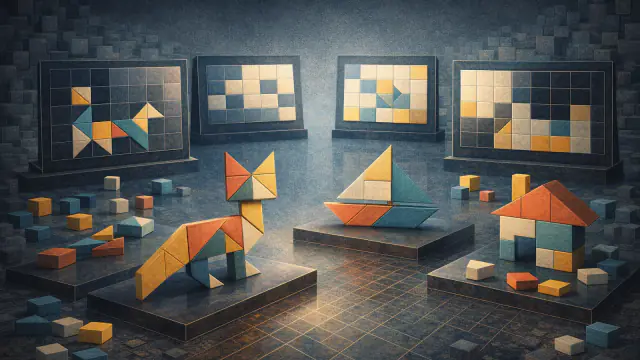
The core rule is to fill a target shape with fixed pieces, without overlap and without gaps. Tangram is the most iconic format: 7 fixed pieces must recreate a given silhouette.
2. Grid movement puzzles
A piece or character moves on a discrete grid under strict movement rules. The classic sliding puzzle and Sokoban belong here. Difficulty comes from planning move sequences rather than isolated moves.
3. Graph coloring and adjacency logic
Nodes linked by edges must satisfy color or state constraints. This family emphasizes local constraints and global consistency.
4. Symmetry and transformations
Rotation, reflection, and translation recognition tasks ask you to identify equivalences across transformed shapes.
5. Dissection and recomposition
One shape is cut into pieces and recombined into another. This is the core logic behind many recreational geometry classics.
Pentominoes: simple rules, deep complexity
Pentominoes are the 12 forms made by combining exactly five squares edge-to-edge. Their visual simplicity hides a large search space and many valid packing configurations.
This is why pentomino logic inspired modern puzzle design, including falling-block and tiling-style games. The same idea keeps appearing in digital puzzle mechanics today.
Why tangram is a strong spatial challenge
Tangram on Kognify keeps the classic format: 7 pieces, one target silhouette, no overlap. Solving requires two skills at once: decomposition (which parts belong where) and transformation (how each piece should rotate/flip).
Abstract silhouettes are often harder than figurative ones because visual analogy is weaker. You must rely on geometry rather than recognition shortcuts.
Grid properties: von Neumann vs Moore
Neighborhood definition changes puzzle geometry dramatically. A von Neumann neighborhood allows 4 directions only (up/down/left/right). A Moore neighborhood adds diagonals for 8-direction movement.
Optimal Path and Box Push use 4-direction logic, which creates specific path constraints and forces right-angle detours around obstacles.
6 Kognify games for spatial reasoning
- Packing a car trunk: real-time 3D tiling and ordering.
- Folding a map: sequence-based geometric transformation.
- Cutting equal cake slices: practical dissection problem.
- Turning furniture through a hallway: rotation in constrained space.
- Loading a dishwasher: irregular-shape optimization under constraints.