
Spatial Intelligence Games Online: Visualize and Manipulate Space
Why do some people read maps instantly while others get lost after one turn? Why does a 500-piece puzzle feel relaxing for some players and frustrating for others? A big part of that difference comes from spatial intelligence, and game-based practice is one of the most engaging ways to work on it.
What is spatial intelligence?
Spatial intelligence is the ability to understand how objects relate to each other in space and to manipulate those relationships mentally. In practical terms, it means imagining rotations, estimating positions, visualizing paths, and spotting structure inside complex visual scenes.
It appears in everyday activities such as reading maps, parking a car, assembling furniture, organizing objects efficiently, or solving geometric puzzles.
Games are useful here because they turn these processes into clear challenges with immediate feedback.
The 4 key components of spatial thinking
Spatial intelligence is not one single skill. Different game mechanics target different components.
Mental rotation: the classic challenge
Mental rotation tasks are a core part of spatial puzzle design. You compare shapes after imagined rotations and decide whether they match. The farther a shape appears rotated, the harder the comparison usually feels, which makes this mechanic perfect for progressive game levels.
Visualization through transformation puzzles
Folding and transformation puzzles test your ability to track changes step by step without seeing each intermediate state. This is why origami-style puzzles, shape assembly games, and visual construction challenges feel so satisfying when they click.
How spatial games challenge your sense of space
Three major game families stand out for spatial practice:
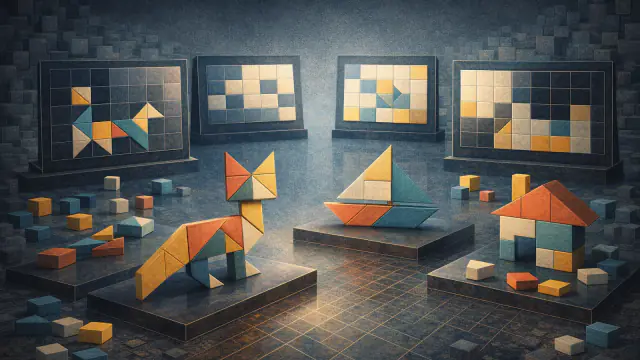
Tangram-style puzzles
You match geometric pieces to a target silhouette. To solve quickly, you have to predict rotations and placements before trying them physically on the board.
Sliding puzzles
Sliding tile games require planning several moves ahead. You are not only solving the current state, you are mentally simulating future board states.
Box-pushing puzzles (Sokoban-like)
These games reward careful planning. Some moves are irreversible, so you must avoid dead-end states while routing objects to target cells.
7 spatial games to explore on Kognify
Kognify includes games that challenge multiple spatial components through different mechanics and pacing:
- Use maps actively: check the route before moving instead of following directions blindly.
- Try folding challenges: paper-folding and origami puzzles are great visualization drills.
- Build things: construction toys and 3D assemblies support the same core processes as digital puzzles.
- Play in short sessions: regular 10-15 minute sessions are easier to maintain than occasional long sessions.
- Mix game types: alternate rotation, navigation, and planning games for broader practice.
Frequently asked questions
What is spatial intelligence in simple terms?
Can adults still improve spatial thinking through games?
Which game mechanics challenge mental rotation the most?
Are there free spatial games on Kognify?
How often should I play spatial games?
Tangram, Box Push, Hidden Links and more. Start playing and challenge your visual reasoning.
🎮 Explore Spatial Games →Instant free access · No download required