

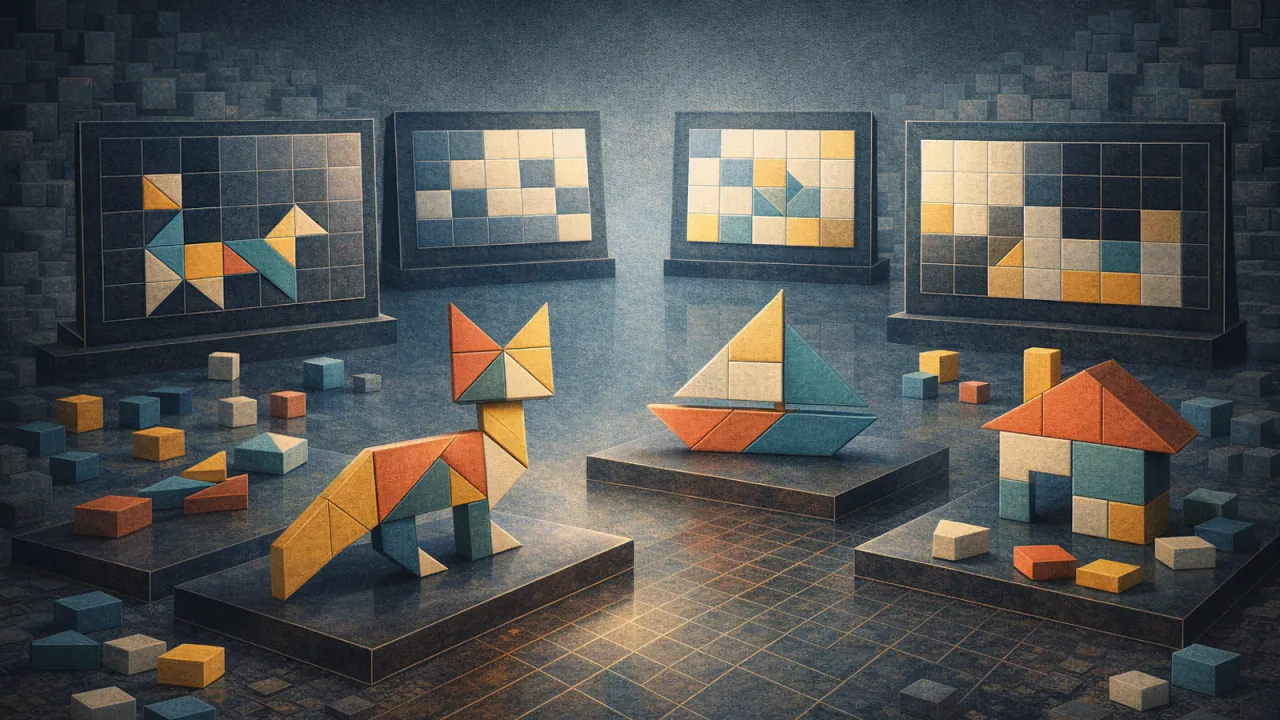
Free Online Tangram: the art of geometric puzzles
Seven pieces. Thousands of silhouettes. Tangram is one of the oldest and most engaging geometric puzzles in the world. Learn its history, rules, and practical solving strategies, then play online on Kognify.
What is tangram?
Tangram is a puzzle of Chinese origin that is nearly one thousand years old. Its Mandarin name, 七巧板 (qī qiǎo bǎn), is often translated as "the seven boards of skill." The game asks you to assemble seven geometric pieces called tans to match a target silhouette: an animal, an object, a character, or an abstract shape.
Introduced in Europe in the early 19th century, tangram quickly became popular in London and Paris under the name "Chinese Puzzle." Since then, it has kept players engaged across generations, from puzzle fans to designers and math enthusiasts.
What makes tangram special is its huge combinational depth: with only 7 pieces, you can build more than 6,000 known silhouettes, and many more if you create your own patterns.
The 7 tangram pieces and how they work
All tangram pieces come from one square split in a precise way. Each tan has different size, symmetry, and rotation options:
- 2 large isosceles right triangles — the biggest pieces, often used as the structural base of a silhouette.
- 1 medium isosceles right triangle — useful for filling awkward angles.
- 2 small isosceles right triangles — flexible pieces that fit many micro-gaps.
- 1 square — the only piece with four symmetry axes.
- 1 parallelogram — the trickiest piece because mirrored orientation matters.
The two essential rules are simple and strict: use all pieces, and do not overlap pieces. That constraint is exactly what makes tangram so satisfying.
Practical strategies to solve tangram puzzles
When a silhouette looks complex, random trial and error is tempting. A structured approach usually works better.
Start with the outline
Inspect the target shape before moving any piece. Look for right angles, sharp tips, wide zones, and narrow zones. This quick visual scan gives you a map of likely placements.
Place large pieces first
The two large triangles represent half of the total tangram area. Once they are placed, the remaining space becomes much easier to decode.
Use symmetry when available
Many silhouettes are symmetrical. If the target is symmetrical, try a mirrored layout early to reduce possible configurations.
Rotate and mirror deliberately
Every tan can be rotated, and the parallelogram can also be mirrored. Do not lock yourself into obvious orientations. A single unusual angle can unlock the whole puzzle.
- Start with simple silhouettes first: squares, rectangles, and triangles made with all 7 pieces.
- If you are stuck for two minutes, reset and try a new approach.
- Remember the parallelogram has mirrored states — this is often the key move.
- Test large-triangle anchors first to frame the composition.
- Expect counterintuitive solutions on advanced silhouettes.
Tangram on Kognify and similar puzzle games
Kognify features Tangram as a Premium game. Each level asks you to rebuild a silhouette by dragging and dropping the 7 pieces. Difficulty scales from clean geometric forms to more intricate abstract layouts. If you enjoy spatial puzzle challenges, these games are also worth trying:
Why tangram is an excellent thinking game
Tangram is more than a quick pastime. It is a strong spatial reasoning challenge built on pattern recognition, planning, and iteration.
Spatial imagination is the ability to mentally rotate objects and predict how parts fit together. Tangram naturally trains this skill because players constantly test orientations before placement.
Patience and persistence are also central. A hard silhouette can feel impossible for minutes, then suddenly click after one perspective shift. That "block then breakthrough" loop is a core reason tangram stays addictive.
Finally, tangram supports creative play. Once you master target silhouettes, you can invent your own and challenge others to solve them.
Frequently asked questions
Is tangram free on Kognify?
Tangram is part of Kognify Premium games. You can access it with a subscription, or play the 9 free demos without creating an account. Start for free, then try Premium free for 7 days if you are eligible: the trial can be cancelled anytime and auto-renews unless cancelled.
How many shapes can you make with tangram?
With only 7 pieces, tangram can form more than 6,000 documented silhouettes, plus many custom creations. Convex solutions are limited, while non-convex possibilities are extensive.
Where does tangram come from?
Tangram originated in China around 1,000 years ago. It became widely popular in Europe during the 19th century as the "Chinese Puzzle."
Do you have to use all pieces in tangram?
Yes. A valid tangram solution always uses all 7 tans and never overlaps pieces.
Is tangram suitable for children?
Yes. Tangram is commonly played from age 5-6 and adapts well to different levels through simple-to-complex silhouettes.
Assemble all 7 tans and solve hundreds of silhouettes. Available on web and Android.
🧠 Start playing9 free demos with no sign-up · Free 7-day Premium trial on request