

Logic games without sign-up solve a very practical problem: you can play fast, with almost no friction, and keep sessions short enough to fit a real day. When you must create an account before the first round, many sessions stop before they even begin. With direct access, you can launch a challenge in seconds and focus on what matters: rules, decisions, and progression.
This format works well for several profiles: people who play during a 5 to 10-minute break, players who want to test multiple game styles before building a routine, and anyone who wants to avoid long onboarding flows. You can start immediately from the games page.
Why no sign-up really changes usage
This is not only about convenience. It has a direct impact on consistency.
- Less start friction: no form to fill in, so more sessions actually begin.
- Simpler decision process: you can test one format, then another, without heavy commitment.
- Shorter and more controlled sessions: instant access supports useful micro-sessions.
- Better mobile fit: open, play, close.
When people look for a game with “no sign-up”, they mainly want to get going: a fast, practical answer, not abstract theory.
The 6 criteria of a good free logic game with no account
If you want a format that lasts over time, check these points before trying too many options.
-
Rules understood in under one minute
A good game explains its objective without overload. -
Instant readability on smartphone
Buttons are large enough, contrast is clear, navigation is simple. -
Progressive difficulty
Accessible start, then gradual increase without a hard wall. -
Clear feedback after each round
You understand why you succeeded or failed. -
Short, interruptible rounds
A 3 to 10-minute session should still feel meaningful. -
Variety of mechanics
Alternating visual logic, deduction, and working-memory tasks prevents boredom.
Which challenge types to prioritize at the beginning
When building a routine, the common mistake is starting too hard, too early. A stable base works better.
- Simple deduction: remove options using clear constraints.
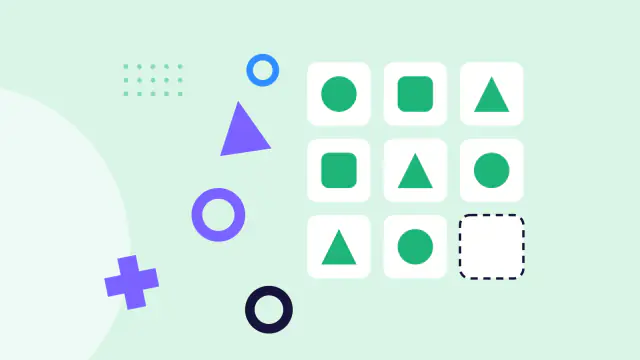
- Short visual sequences: detect a logical pattern in a few steps.
- Compact grids: small size, quick reading, clear objective.
- Round-based puzzles: fast finish, easy restart.
The goal is not very long performances. The goal is sustainable frequency.
14-day routine to make practice consistent
Here is a simple framework that works for most players.
Week 1: stability
- Day 1 to 3: one single format, 5 to 8 minutes.
- Day 4 to 7: same format, up to 8 to 10 minutes.
Objective: understand the core mechanic and avoid constant switching.
Week 2: controlled variation
- Day 8 to 10: format A (5 min) + format B (5 min).
- Day 11 to 14: alternate A/B according to your energy level.
Objective: keep consistency while adding limited variety.
Mistakes that make people quit too early
Even good games fail if habits are unstable.
- Changing format every session: you lose your reference points.
- Chasing speed before accuracy: errors accumulate.
- Extending sessions without breaks: quality drops quickly.
- Playing only when you feel “motivated”: routine becomes fragile.
Simple rule: 8 focused minutes, 4 times a week, usually beats one irregular 40-minute session.
How to organize mobile sessions
Mobile is ideal for this usage if the session stays structured.
- Open a game with a precise objective (for example: 2 clean rounds).
- Cap the session at 10 minutes.
- Take a 1 to 2-minute break before restarting.
- Stop as soon as concentration drops.
On Kognify, you can chain sessions directly from the games page while keeping this structure.
FAQ
Is a no-sign-up game automatically lower quality?
No. No-sign-up affects access, not quality. Quality depends on rules, readability, and progression.
How long should a session be to stay useful?
For most players, 5 to 12 minutes is enough when practice is regular.
Should I stick to one single logic format?
At first, yes. Later, alternating two formats is usually the best balance between stability and variety.
Is this suitable for beginners?
Yes. No-sign-up formats reduce friction and make first attempts easier.
Where should I start on Kognify?
Start from the games page, pick a simple format, and keep the same routine for several days.