

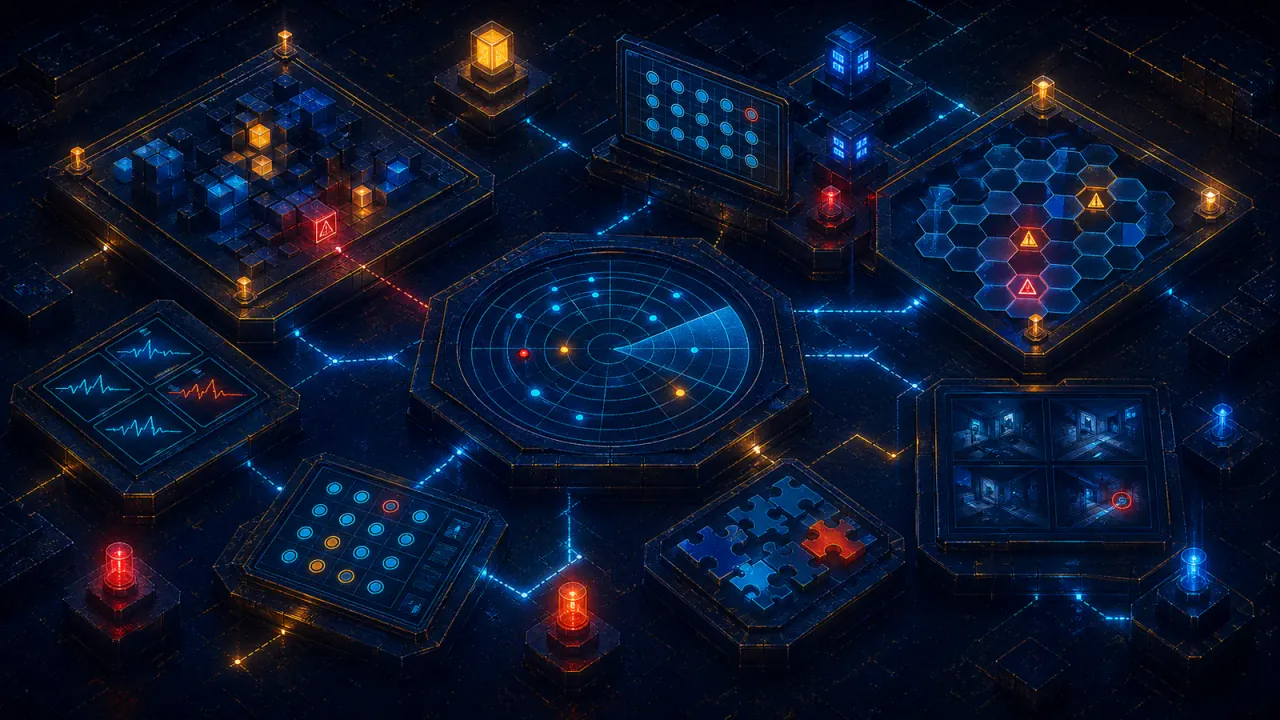
Online vigilance games test a simple but demanding skill: staying attentive when a task becomes repetitive. At first everything feels easy, then focus drops and mistakes appear.
The goal is not to move faster at any cost, but to keep a stable alertness level throughout the session.
Vigilance and attention: what is the difference?
Attention can be intense for a few seconds. Vigilance is about continuity:
- staying precise after several minutes;
- detecting rare signals;
- avoiding mistakes caused by mental drift.
In a game, the gap is clear: strong start, then lower precision if your rhythm is not controlled.
Why we make more mistakes after a few minutes
Three causes are common:
- monotony: the task feels identical, alertness drops;
- anticipation: you click before confirming;
- visual fatigue: small details become harder to read.
This is normal. The practical fix is to adjust your session format.
Game formats that train vigilance well
| Format | What it demands | Common mistake |
|---|---|---|
| Target detection | Sustained alertness | missing a rare signal |
| Fast comparison | Continuous visual control | mixing up close details |
| Timed sorting | Stable rhythm | accelerating too abruptly |
| Short timed puzzle | precision under time | rushing the end |
You can alternate with selective attention games and spot the difference games.
Short session method (5 to 8 minutes)
Simple routine:
- minute 1: moderate pace, zero mistakes;
- minutes 2 to 5: slight speed increase;
- last minute: back to strict control.
This structure limits the “I speed up too much, then lose track” effect.
When you feel your focus drop, slow down on purpose for 10 seconds. This micro-reset often prevents a cascade of mistakes.
How to avoid end-of-round drop
The end of a session is the most fragile moment. To stay clean:
- keep a regular cadence;
- re-check risky actions;
- avoid impulsive clicks in the last 20 seconds.
This small framework improves score stability a lot.
Where to practice online vigilance games
On Kognify, the easiest setup is to rotate three formats:
- pure vigilance (detection);
- sorting or concentration;
- short logic puzzle.
You can build this routine from the Kognify games page, then vary with concentration games.
FAQ
What is a vigilance game?
A vigilance game asks you to maintain stable attention over time, often by spotting rare signals.
Why does vigilance drop with time?
On repetitive tasks, alertness gradually falls. Visual precision drops and mistakes become more frequent.
How long should one session be?
Blocks of 3 to 8 minutes are effective for vigilance practice without excessive fatigue.
Which online formats are best for vigilance?
Target detection, fast comparison, and progressive visual control games are strong formats for vigilance.